

Monthly talk: Clare Densley – Honeybees at Buckfast Abbey
From Flower to Jar
Our guest speakers in November were Clare and Martin, bee keepers at Buckfast Abbey who gave a fascinating and very entertaining talk about how honey is made. They stressed from the outset that it not the bee keepers but the bees who do all the work – and they do it for themselves not for us. The honey is to feed themselves, and they will produce as much as they need to get through the winter.
After long careers as bee keepers, Clare’s and Martin’s knowledge is impressive but they managed to share just a little of it with us without overwhelming us. However, what they did demonstrate conclusively is how remarkable bees are, and how extraordinary is their life within the hive.
Bees don’t hibernate but the population of a hive does diminish from about 70,000 in the summer to about 17,000 bees in the winter in a typical hive. Their sole purpose is to maintain the queen at the heart of the community, so that she can lay eggs for the coming season. They organise themselves with a cluster of younger bees around the queen, whose task is to ensure her well-being by activities such as cleaning to prevent disease. Outside this layer, are ‘middle aged’ bees who engage in what was described as ‘heavy duty shivering’ to maintain the temperature of the hive at a very precise level of 35 degrees. This is achieved using extraordinary skill, with bees able to increase their metabolism to increase the temperature by as much as 25% if required. Outside these bees is a further layer of older bees (in their Third Age, perhaps?) whose role is to hold the heat inside the cluster. In a mild winter, some bees might emerge for a while to forage but on the whole, they remain inside the hive.
During the winter, the hive will consume about 35 pounds of honey. Bee keepers encourage the hive to produce more honey than this for human consumption. However, at Buckfast, they make sure that they do not take more honey than this and will not take artificial steps to increase production.
Bees are, of course, vegetarians. They collect pollen from flowers as their source of protein, and nectar for carbohydrates. We were shown illustrations to understand how the ‘design’ of bees enables them to collect the pollen and nectar, and how different flowers present different challenges for varieties of bees.
Life and work is highly specialised within the hive, and not for nothing are bees often described as ‘busy’. A bee may need to visit up to 150 flowers to fill its crop with nectar. Bees have remarkable methods of communication. ‘Scout bees’ have the task of venturing out to find out where the best flowers are located. They show ‘forager bees’ where to go by performing complex ‘waggle’ dances which give directions and distance. They are the only creatures other than humans to use symbolic language.
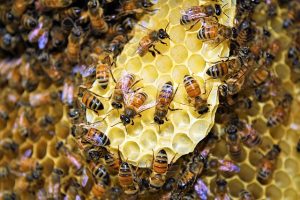
When a bee returns to the hive, it regurgitates nectar to ‘unloading’ bees who take it inside the hive where large numbers are dedicated to fanning the nectar to adjust water levels to the required level of 18%, and create the right microclimate. The bees make wax cells where the honey is stored, after being sealed and with an added enzyme from their saliva which turns to hydrogen peroxide, the substance which is so effective in healing wounds.
Bee keepers take the honey in either the spring or summer. Not surprisingly, the bees resist so there are various techniques to do this successfully and without harming the bees. Once it is collected, there are different ways of preparing the honey for consumption. Clare and Martin’s absolute favourite is to eat it from the wax cells.
We got important advice on what to buy. We need to be on the alert for product which is labelled as a ‘blend of EU or non-EU’. Despite what it may say on the label, Clare and Martin say this will not be pure honey, and will contain a large proportion of sugar syrup. Almost all supermarket honey, including ‘prestige’ brands, have failed tests to demonstrate which is pure honey. If we are cooking with it then that is not a problem but if we want pure honey on our bread, then we should ensure that we read the label to see where it is produced. A good guide is to buy locally produced honey from a named producer. In good Dawlish fashion, Gaye’s Creamery honey is highly recommended! Honey is a luxury product, and entails a great deal of work (from bees and humans) to produce, so it is unrealistic to expect it to be anything other than expensive.
Manuka honey from New Zealand has a high reputation for its therapeutic qualities. This is certainly justified when it comes to being applied as a dressing for wounds, and there is strong evidence that it is very effective in aiding healing. However, Clare and Martin argued that all locally produced honey will be beneficial (as well as enjoyable) and there is no reason to believe that Manuka honey is any more beneficial as part of our diet.
Honey comes in a wide variety of colours and consistencies. Some are very dark and are likely to come from bees harvesting tree nectar as the trees are likely to be bringing up minerals from deep in the earth. Some are much more likely to become crystalline than others. If you wish to make these runny, you should put the jar to warm gently in warm water, no more than 60 degrees. Over heating will harm the product and its therapeutic qualities.
It is no surprise that bees have been a subject of fascination to mankind for millennia. In their talk, we were only scratching the surface, but Clare and Martin gave us a glimpse into this extraordinary subject which may tempt us to find out more – as well as to eat the best we can afford!
I am not sure whether there will be any honey on the menu, but please remember that our next ‘meeting’ is our Christmas Lunch on Monday 15th December at the Langstone Cliff Hotel. Khim Sim has been keeping all those who are planning to attend very well informed of the arrangements – including the parking arrangements for those going by car. Don’t forget to register your car at reception if you don’t want to incur a parking fine!
See you there, with or without a Christmas jumper!
John Vick