

Art Appreciation – November/December 2025
Fourteen people attended the November Art App meeting, probably a record, so it is most encouraging to have such an active and lively group. The topic this time was ‘Other Cultures’ or ‘Cultural Encounters’, and predictably there was a wide and often surprising range of works of art to learn about.
We started with the extraordinary Giant Reclining Buddha in Wat Tho, Bangkok. This sculpture, covered in gold leaf, is so large it is almost impossible to capture in a single photograph.
As expected, there were several works of art either from Japan, or inspired by Japanese art. Hokusai is probably best known for ‘The Wave’ which is reproduced in posters, tee shirts and other media. Less known is his 1814 work, ‘The Dream of the Fisherman’s Wife’, an example of erotic art which is part of a major tradition in Japanese art. We learned not only about this disturbing and fascinating image but about the folk tale which inspired it.
Many 19th century European artists were inspired by Japanese, including Van Gogh. We saw his interpretation of the Japanese paintings, ‘The Plum Garden’ and of a courtesan, side by side with the originals.
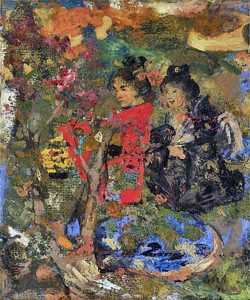
One of the group of artists known as ‘The Glasgow Boys’ was Edward Hornel (1864-1930). Born in Australia of Scottish parents, he moved to Scotland and became interested in Japanese prints. Unusually, he travelled and explored extensively in Japan, experiencing more of everyday life than most visitors. Hornel was unfamiliar to most of the group but members greatly enjoyed the vibrant colours and images of geishas, tea houses and social life in his works.
We next looked at beautiful artefacts from the ancient Minoan civilisation of Crete. There are many legends recorded in Greek literature relating to the island, notably concerning King Minos and the Minotaur. Much of the art work relates to bulls but there is also many examples of decorative jewellery and religious objects.
We moved on to the west coast of Canada to see ‘The Raven and the First Men’, a contemporary work which was made by sculptor Bill Reid in partnership with Haida artists. This tells the story about how man was created. A raven opens up a clam shell from which the first men emerged.
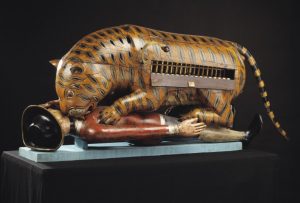
A cultural encounter of a very different sort was portrayed in ‘Tipu’s Tiger’, made in Mysore in the late 18th century, a time of warfare in India between Tipu Sultan and the armies of the East India Company. This automaton shows a tiger mauling a European soldier. It has moving parts and offers sound effects of screams and roars. It is one of the most popular works of art currently on display in the V&A.
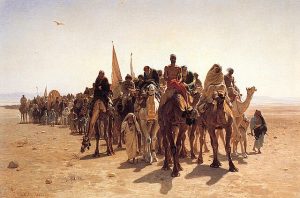
Throughout the 19th century, Europeans’ fascination by ‘the orient’ and the Muslim world, produced a great deal of art. Not all of it was based on real knowledge and understanding of the society, but Pilgrims going to Mecca by the French artist Léon Auguste Adolphe Belly (1827–1877) was based on his own observation in the region.
We moved to China and had a rapid overview of many centuries of art where to the ‘inexpert’ eye, it is hard to detect significant changes in style or subject matter. The settings were stylised, and the figures portrayed were largely members of social elite groups. We then moved to the middle of the 20th century, a period of civil war, social dislocation and destruction and saw paintings which had very different subject matter. Influenced by trends in western art, the subjects were ordinary people, clearly refugees and homeless, not the scholars and privileged people who dominate earlier work. There were striking similarities to the Chinese tradition though, notably that they were placed against a background which was essentially blank.
Killerton’s current exhibition of costumes from the 1920s includes many items inspired by ancient Egypt. The ‘Art Deco’ movement between the wars used many Egyptian motifs in architecture and design, relishing in the opulence revealed by the discovery of Tutankhamen’s tomb and other archaeological discoveries of the 1920s.
Our final dip into another culture was the Iberian culture of pre-Roman Spain and Portugal. The news has recently included coverage of the theft of works of art from the Louvre, but this is nothing new. We learned about the theft a century ago of Iberian sculptures from the Louvre which clearly inspired some of Picasso’s art, and it is quite possible that Picasso himself was involved – but the matter was never resolved!
Our next meeting will be on Tuesday 9th December when members are invited to select a work of ‘Extravagant Architecture’ to talk about for a few minutes.
Lynne Vick, Convener