
Art Appreciation – January 2026
For our January meeting, Michael Heyden gave a presentation on Camille Pissarro (1830-1903). Though often thought of as a French artist, Pissarro was in fact born in 1830 the Caribbean on the island of St Thomas in the Danish West Indies, now the U.S. Virgin Islands. His father was of Portuguese Jewish descent but held French nationality. He had come to the island from France to deal with the estate of his uncle who had died and whose widow he later married.
At the age of twelve Camille was sent to school near Paris where he developed an appreciation of art and gained a grounding in drawing and painting. After his schooling at around the age of sixteen, he returned to St Thomas to work with his father, but continued to draw in his spare time. Eventually, at the age of twenty one he decided to pursue a career as an artist. His early works show landscapes and scenes of everyday life on St Thomas and in Venezuela where he lived for two years.
In 1855 he moved back to France and was tutored by Corot. Both shared a love of nature and Corot encouraged him to work in ‘plein air’. Whilst initially Pissarro worked in the traditional style required by the Paris Salon, he increasingly worked outdoors, completing pictures in one session rather than finishing them in the studio as was Corot’s way of working. The result was a more spontaneous style which was considered to be ‘unfinished’ by critics at the time.
In 1859, he came into contact with younger artists, Claude Monet and Paul Cezanne, who shared his dissatisfaction with the constraints of the Salon’s requirements. Their friendship led to the staging of the exhibition of the ‘Salon des Refuses’, and later to the Impressionist exhibitions. He is credited as being a father figure of the Impressionists. He also associated with Post Impressionists such as Gauguin, Van Gogh, Seurat and Signac and experimented briefly with Post Impressionist techniques, notably pointillism.
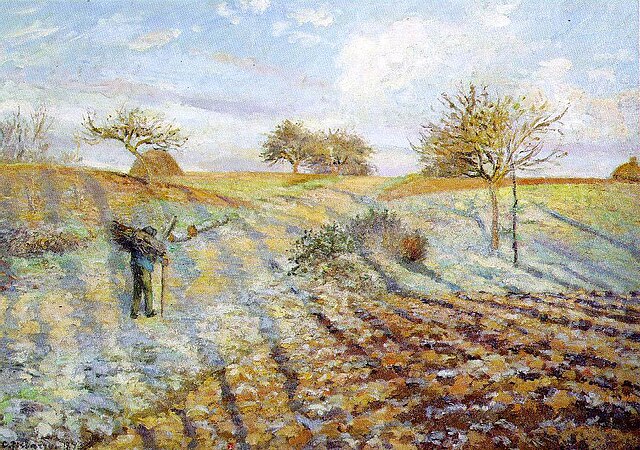
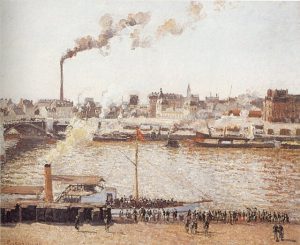
We only had time to look at relatively few of his works as his output was prolific. Most were beautiful rural landscapes in France, some showing the life of agricultural workers, similar to subjects of works by Courbet and Van Gogh. However, in common with Monet, he spent the duration of the Franco-Prussian War in London, producing many paintings of the London area. Whilst I was familiar with his landscapes, we also saw examples of portraits and still life.
Many thanks to Michael for showing us what an important and versatile artist Pissarro was.
John Vick