
Art Appreciation – December 2025/January 2026
As most of our meetings focus on paintings rather than any other art form, we decided to have a rather different theme in December, ‘Flamboyant Architecture’. The term ‘flamboyant’ opened up all sorts of possibilities.
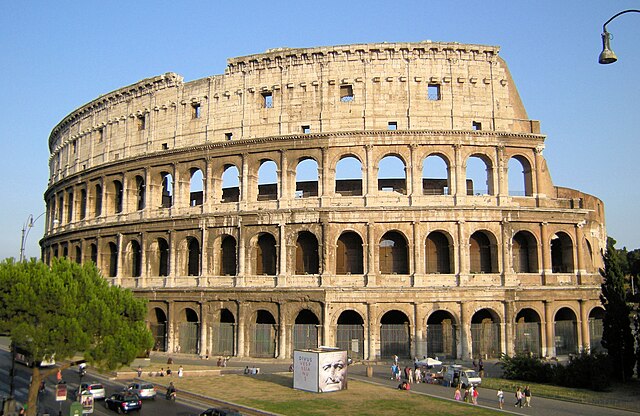
We began with one of the most famous buildings in the world, the Colosseum in Rome. This remarkable structure was the venue for spectacular public entertainments, many of them brutal and bloodthirsty. It accommodated crowds similar to the largest sports stadiums today, and its elegant design was also adorned with statues.
One of the most beautiful and visited buildings in the world is the Alhambra in Granada, built by the Islamic Nasrid dynasty from the 13th century. This consists of a wide range of buildings, palaces, gardens and administrative buildings which are characterised by slender and graceful arcades, tranquil gardens, exquisite use of water, elaborate decoration, ceramic tiles and panoramic views.
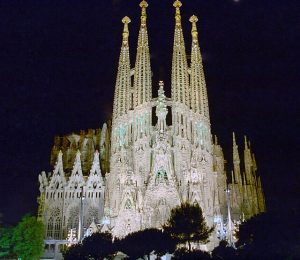 Spain boasts what must be one of the most flamboyant buildings in the world, the Sagrada Familia basilica in Barcelona. It was started in the early 20th century but is still to be completed. The architect, Antoni Gaudi, used gothic forms but in an extraordinary way, combining it with art nouveau and his own unique style. Its spires tower over the Barcelona skyline and its walls are covered with intricate and fascinating decoration.

2025 saw the passing of one of the most significant architects of our age, the Canadian American, Frank Gehry. He has designed some of the most remarkable buildings in the world, and several of which are, again, in Spain. The Guggenheim Museum in Bilbao houses a collection of art but is really a work of art in itself. It is a mass of curves, extraordinary vistas and metallic finishes which reflect the light and water of the harbour on which it is situated.
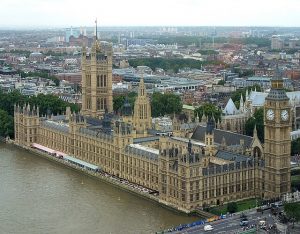 Some of the most flamboyant architecture in Britain came from the gothic revival era in the 19th century. Most familiar is the Palace of Westminster. Built in the 1840s, it replaced a medieval building destroyed in a fire. While the gothic decoration harks back to earlier times, it used modern materials and innovative technology. Interiors are covered with massive murals celebrating British history and mythology, adorned with opulent, gilded thrones and grand vistas.
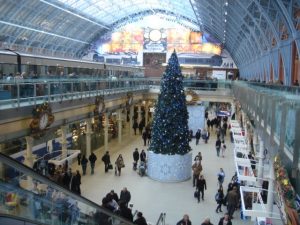 From a similar period, architects celebrated one of the marvels of the age, railways. Perhaps the best example is St Pancras Station and the adjacent Midland Hotel, a triumph of modern engineering but masquerading as a medieval fantasy.
Many of the buildings members chose make you smile. Kansas City Library is adapted from a bank with classical porticos but it proclaims its new purpose with a multistorey car park lined with massive book spines celebrating great works of literature. The interiors also continue the theme, while the former bank vault has been converted into a cinema.
Some of the most flamboyant architecture over the centuries has been ordered by egotistical authoritarian leaders. This has been the case for kings and emperors (think the Palace of Versailles) but is still the case today. Unlike Bilbao or Granada, not many of us will have visited Ashgabat, the capital city of Turkmenistan. The city centre consists of buildings commissioned by its president to celebrate the regime, and the term ‘flamboyant’ hardly does it justice. The grand buildings are all built of white marble imported from Italy and China and decorated with gold. These immense, often impressive but frequently bizarre structures are immaculately maintained but are largely soulless, and don’t appear to serve any genuine purpose to benefit the population as a whole.
Our first meeting on 2026 will be at 2pm on Tuesday 13th January when Michael will give a presentation on the impressionist painter, Camille Pissarro.
Lynne Vick, Convenor