
Art Appreciation – April/May 2026
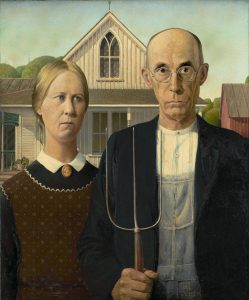
For their April meeting, members were invited to select a work of art on the theme of ‘Old Age’. We started with a famous image by the American artist Grant Wood. ‘American Gothic’ (1930) depicts a couple of farmers, both grim faced with the husband holding a pitch fork, and standing in front of their wooden house. It seems to typify the stoic endurance of a generation of farmers who suffered great privation during the depression.
The rather lugubrious theme was continued by a self-portrait by El Greco painted in the 1590s. Although he was only in his 50s at the time, this reminded us that the definition of ‘old age’ has probably changed significantly over time.
Gustave Courbet’s ‘Old Man with a Glass of Wine’ (1860) was a ‘realist’ painting which aimed to depict everyday life without compromise. The ravaged features of this old man were graphically portrayed. The glass of wine in his hand was probably not his only drink that day!
After so much gloom, it was a relief to find some more positive images of what old age can offer. Honoré-Victorin Daumier produced a number of pictures on a theme of older men enjoying some leisure time and a common interest in ‘The Print Collectors’ (1860-64).
The Dutch artist Pieter Claesz reminded us about the reality of death with his ‘Still life with a skull and writing quill’ (1628). The genre of ‘memento mori’ paintings was popular in that period, full of symbols showing how ultimately insignificant are the things which preoccupy us in life.
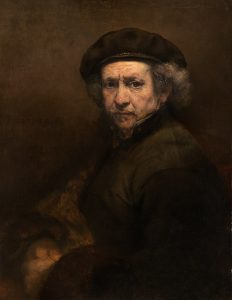
Throughout his life, Rembrandt produced a great many self-portraits and these show his progress from a young man full of promise, becoming a successful artist and prosperous family man, through to a troubled and sad figure preoccupied by bereavement and financial woes in his declining years.
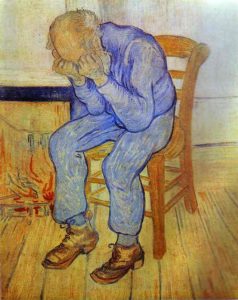
Vincent Van Gogh’s ‘Sorrowing Old Man’ (1890) was another sobering image focusing on the physical and emotional decline of old age. Likewise, Gustav Klimt’s ‘The Three Ages of Woman’ (1905) presents an uncompromising portrayal of childhood, motherhood and the physical decline of old age. It is far removed from the glamorous images which are so characteristic of much of Klimt’s work.
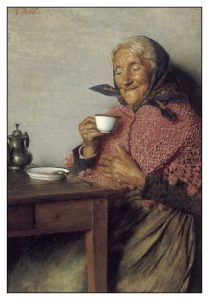
Gaetano Bellei (1857-1922) produced many images celebrating the relationships which grandmothers had with their younger family members, and the fun to be had with old friends, enjoying the time old age offers for recreation. ‘Grandmother and granddaughter’, ‘A Good Brew’ and other of his paintings are warm and engaging.
A very different take on old age was Cranach’s intriguing ‘The Fountain of Youth’ from 1546. It shows old women being taken to a large pool with a fountain. As they experience the waters and move from one side to the other, they regain their youth and beauty, and emerge transformed and able to enjoy dancing, feasting and all the good things of youth. It seems that old men did not need this fountain of youth, but were rejuvenated by the company of younger women!
We ended with a selection of the nation’s favourite images of old age produced by Beryl Cook. Old men and women playing tennis, dancing on a cruise ship, or having tea in the garden – naked! – these came as a considerable relief after the largely negative images of physical and emotional decline which characterised so many of the other choices. Beryl Cook and Gaetano Bellei’s work reminds us of the positive side of living in our Third Age.
At our next meeting on Tuesday 12th May, Molly will give a presentation on Anatomy in art.
Lynne Vick, Convenor