
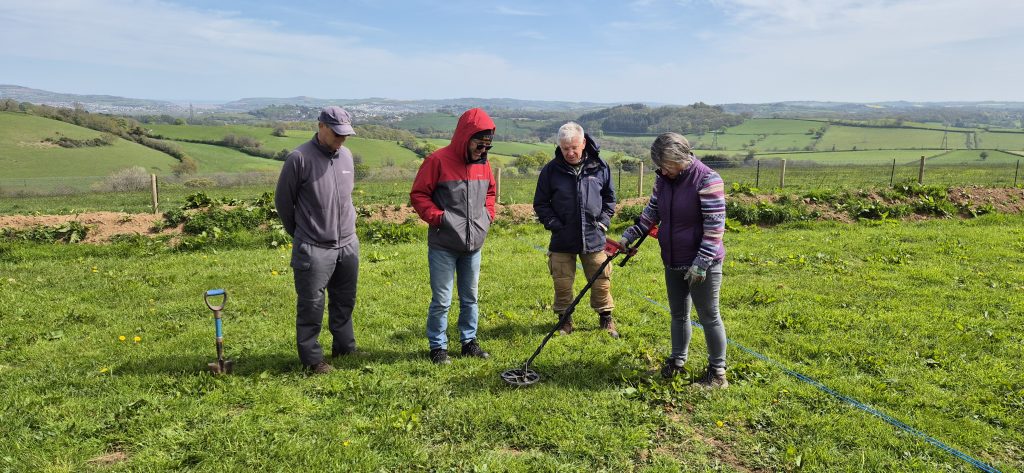
Adventure group detectorists find hoard of pennies!
April’s adventure for the u3a Adventure Group was metal detecting. We were very lucky because this would not just be a have-a-go experience; we were to receive some training from a very experienced detectorist and archaeologist, who teaches at Exeter University and has appeared on TimeTeam and Digging For Britain.
It was a gloriously sunny day when eight of us met the course leaders at a farm on the edge of Dartmoor. However there was a chill wind blowing so we were well wrapped up with lots of layers. We took a short walk up the hill to our outdoor classroom, laid out with a gazebo and coffee station and enough camping chairs for everyone.
The course began with some health and safety information (of course!) and then we began to learn about what constitutes treasure and what the law says you have to do with it if you find any. We also had an interesting talk about the difference between detectorists and archaeologists. We heard that detectorists may not always be helpful to the study of archaeology because in digging up an artefact, they spoil its context. However there are ways in which the two specialists can help each other and work together.
We learned about how a metal detector works – basic physics apparently but not basic enough for me! After this we looked at the model we would be using and reviewed it’s different features. A modern metal detector does a lot more than just beep when it passes over some metal. It has an information screen that can tell you what type of metal you have found so that you know whether to get excited about a potential hoard of gold or leave a rusty nail where it is! It can also tell you how deep the object is. With more sophisticated and expensive machines the experienced detectorist can gain even more information from the pitch of the bleeps and the readout on his screen.
Now we made our way to the detection site on the other side of the hedge, where we felt the full force of the Dartmoor wind. It was a lovely flat area with a magnificent view across to the coast at Teignmouth. On less windy days it would have been an ideal picnic site where people could easily have lost small metal objects while admiring the landscape!
We worked in teams of four, with one person working the detector, making steady sweeps close to the ground and watching the screen and listening to beeps. When they found a strong signal they covered the area with sweeps at right angles in order to hone in on the location and then they pressed a special button which made the machine make a Doctor Who type noise to locate the object precisely. The second team member then used a shovel to dig out a cube of soil. The detectorist then used the detector to check if the object was in the hole or in the soil. After this the third team member came in with a pinpointer which only made a noise when it was very close to a metal object. The fourth team member then knew where to scrape with their trowel. We were told that any find would belong to the detectorist and they should be the one to pick it up.
We all had a go at all the different roles and soon it was my turn to be the detectorist. I was very excited when the machine began to bleep with a good strong signal and my team mates were able to swing into action. A short scrape with the trowel revealed a piece of treasure which I eagerly picked up and wiped clean with my glove. It was a Victorian penny dated 1898!
By the end of the session all eight of us were clasping late nineteenth and early twentieth century pennies. There must have been some very careless picnickers over the years!
At one point our team found a very strong signal which mystified our instructor. We dug down deep and then deeper still but found no treasure. We had the instructor and his associate both taking their turn and agreeing that there was ‘something’ there. We got a glimpse of how the experienced detectorist behaves when they think they might be on to something. Unfortunately nothing turned up and eventually we were encouraged to look elsewhere.
At the end of the afternoon we carried all our equipment back down the hill and left the field looking as if nobody had been there but I wonder if someone will return and hunt again for the mysterious unknown object!
Deborah Wallis
(This post was originally published in Deb’s personal blog, Deb’s 60 things.)