
Art Appreciation – October/November 2026
The theme of the October meeting was ‘Cityscapes’. Members were asked to choose a work of art on this topic and lead a short discussion about it. The choices ranged from the 17th century and to somewhere in the future, but also with a detour into a world which was a mix of fantasy and powerful reality.
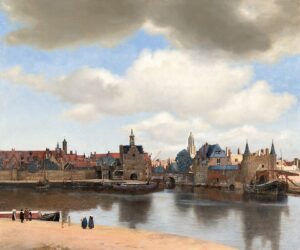 Vermeer is best known for his beautiful interiors portraying everyday domestic scenes. He did, however, produce a very small number of exteriors including a view over his home city of Delft, painted in 1661. It is an extraordinarily realistic view of the city. It portrays the city as one of remarkable calm and serenity, but on reflection this is rather unlikely given the central role that trade and shipping played in its life. Proust thought it was the most beautiful painting in the world, while the verdict of the art historian Andrew Graham-Dixon, seems entirely appropriate: “He took a turbulent reality, and made it look like Heaven on earth.”
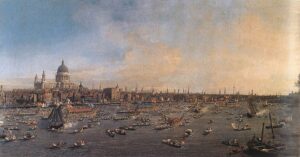 Canaletto was the choice of two members. One painting was set in his most accustomed location of Venice, but this was not of canals and gondolas but of a Stonemason’s Yard. It is full of details of everyday life and work, with many of the city’s famous landmarks in the background. Canaletto also spent a lot of time in England. His view of The River Thames with St Paul’s on Lord Mayor’s Day, 1746-7, has many features which remind the viewer of Venice. There is a grand procession on the water with a number of impressive barges which might have been influenced by Venetian designs. The city is shown just a few decades after it was devastated by the Great Fire, and the skyline is now punctuated by scores of spires, many of which would have been designed by Christopher Wren as, of course, was St Paul’s Cathedral which dominates the skyline.
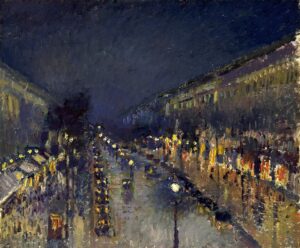 Camille Pissarro was one of the leading Impressionists. Monet is famous for producing a series of paintings of Rouen Cathedral in different lights. Pissarro did something similar for the Boulevard Montmartre in 1897. We saw just five of a much larger number of paintings, where Pissarro observes the Boulevard from the same vantage point but at different times of the day and in different seasons. He skilfully portrays a great range of colours, weather conditions, light effects – both natural and artificial, and the busy life of the street.
The beauty and broadly positive views of city life in these earlier works were in sharp contrast to the grim view of industrial cities by Hans Balusheck. Working in the Germany of the first decades of the 20th century, he focused on the brutal reality of overcrowded apartment blocks, industrial buildings and railways alongside people’s everyday struggle to cope with work and bitter winter weather.
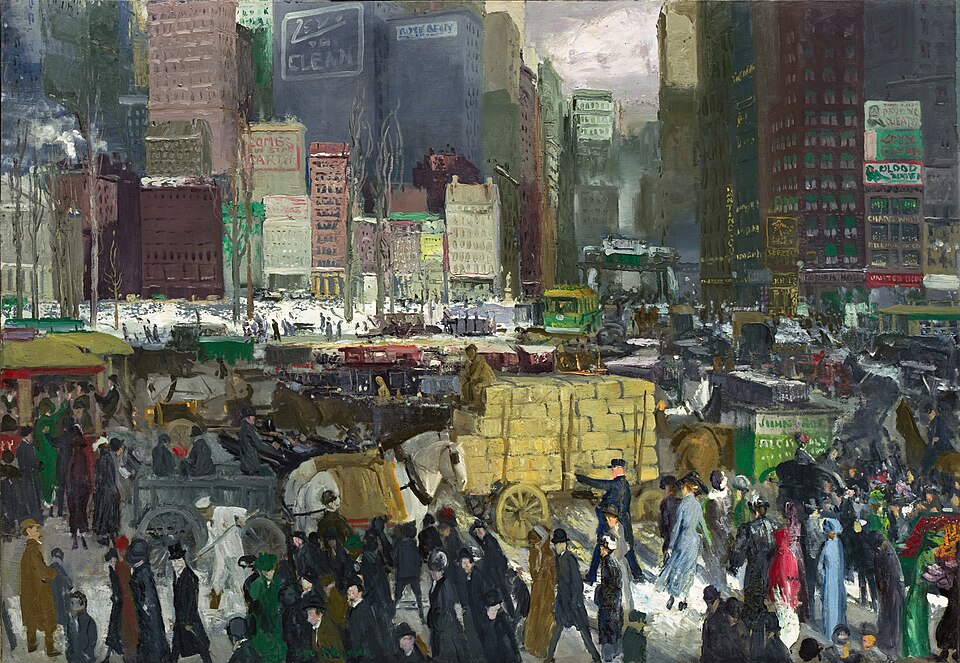
At the same time and in similar unromantic fashion, the American George Bellows portrayed the reality of life in the rapidly growing New York. Unprecedented economic growth and technological change alongside phenomenal population growth produced a cityscape which was dynamic, dramatic and hectic. His painting of New York in 1911 (main photo) shows a tumult of people, transport of all kinds with remarkable skyscrapers on all sides. His focus was on the lives of ordinary people living in this new world, many of them recent migrants forced to live in overcrowded, insanitary tenements.
One of the most popular British artists who specialised in cityscapes and urban life was LS Lowry. Living and working for the most part in Salford and industrial Lancashire, his paintings of factories, usually with tall chimneys belching smoke, are instantly recognisable. They are peopled by his famous matchstick men and matchstick cats and dogs. It was particularly interesting to have an interpretation of the Street Scene in Pendlebury which, on closer examination, shows the result of war time bomb damage and shored up walls where some individual houses in the middle of a terrace have been destroyed.
Our final cityscapes was something very different, although closely related in theme to the work of Bellows in New York. The Australian artist Shaun Tan produced a book ‘The Arrival’ which tells its story entirely through beautiful, mysterious pictures. The theme is of family separation, migration, journeys to an alien and frightening world of towering buildings and overcrowded living. The book is a work of art in itself, and its moving story appeals to people of all ages, and has considerable resonance in today’s world.
As something of a detour from the main theme, we had a look at what might be possible in the world of art produced by AI. It started with a view of Rome and then the project had a life of its own! We saw some intriguing works of art which resulted from an instruction to produce a picture of a given subject in the style of a well-known artist. We looked a photograph of the colosseum in ancient Rome interpreted in the style of the surrealist Magritte. Also generated by AI were a cubist cityscape, and the Eiffel Tower with a crowd of unmistakably Beryl Cook tourists having fun.
Our next meeting will be on Tuesday 10th November when Michael Heyden will give a presentation on the American artist James McNeill Whistler.
Lynne Vick, Convenor