
Art Appreciation – August/September 2026
The theme for the August meeting was ‘Journeys and Travel’ which seemed appropriate for the holiday season. This prompted another fascinating range of art works chosen by members of the group.
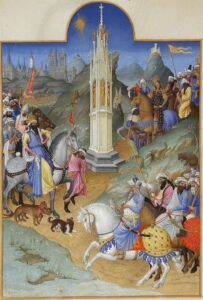
We began with an image of The Meeting of the Three Magi from a French 15th century ‘Book of Hours’. We learned how these sumptuous books were made and how their wealthy owners used them, for religious devotion but also as a sign of status. The selected picture shows in fantastic detail and jewel like colours the meeting of Melchior, Balthazar and Caspar. The location is supposedly in the Holy Land, but in the background are buildings which contemporaries would recognise clearly as Notre Dame and the church of Sainte Chappelle in Paris.
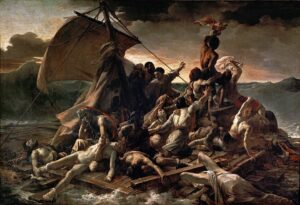 Theodore Gericault’s The Raft of the Medusa (1819) is a vast, dramatic painting of an ill-fated journey which ends in a shipwreck. The event attracted great public attention in France. The small number of desperate survivors are shown frantically trying to signal to a ship on the far off horizon while a wave threatens to swamp their raft.
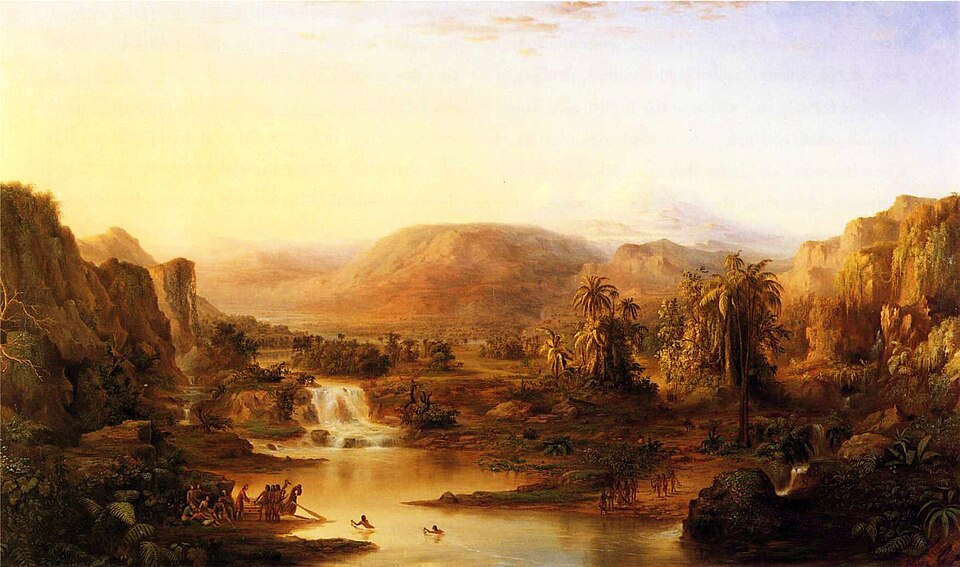
The choice of the American artist Robert Duncanson’s The Land of the Lotus Eaters (1861) was prompted by the recent release of the film ‘The Odyssey’. The painting (featured above) shows Odysseus and his sailors being seduced into remaining in this beautiful landscape rather than continuing on their mission to return home.
Stanhope Forbes is one of the best loved painters of the Newlyn Group. For an earlier generation, holidays in this part of the world would be often include a railway journey on the GWR. Forbes’ evocative paintings of the busy platform of The Terminus (Penzance Station) and Through the Marshes recall the heyday of the age of steam.
A somewhat less enjoyable form of transport was the unexpected subject of several pictures. The ‘tumbril’ was notorious as the cart which took condemned men and women on a one way journey to the guillotine in revolutionary France. We saw portrayals of one of the most famous ‘passengers’ on a tumbril, Marie Antoinette, a number of engravings and paintings, and a drawing by Jacques-Louis David.
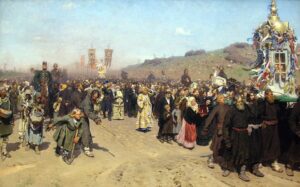
The late 19th century Ukrainian painter Ilya Repin focused on portraying the reality of life in the Russian Empire. His large, dramatic canvas of the Religious Procession in Kursk Province, (1880–1883) shows thousands of pilgrims from all social classes, walking through dusty and sweltering conditions following a revered icon.
A complete contrast was provided by the paintings of Maud Lewis. She was a self-taught, artist born in the early 1900s in rural Canada. ‘Maudie’ was born with a number of birth defects which restricted her mobility. She was introduced to art by her mother, who encouraged her to paint Christmas cards. Her work in naïve style, gained interest and today attract high prices. She enjoyed painting scenes of everyday life in her rural community, often including vehicles such as lorries, sleighs and horse drawn carriages.
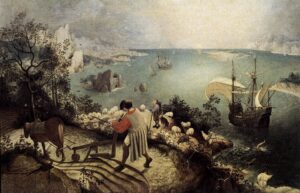 The final group of pictures all related to the development of air transport. Landscape with the fall of Icarus (1590-95) is often attributed to Peter Bruegel the Elder, although that is now in doubt. Nonetheless, it is a popular image, showing the consequence of Icarus’s failure to follow his father’s advice. Flying too close to the sun, the heat melted the wax in his wings, and he plunged into the sea, largely unnoticed by fishermen, farmworkers and others who are just getting on with their lives.
Prompted by recent television coverage of the spectacular balloon festival in Bristol, we saw some paintings of balloons, from the early 19th century as well as more recently.
In the 1920s, the ‘futurists’ were excited by a less leisurely means of air transport: the aeroplane, and especially its possibilities for warfare. Tullio Crali produced dramatic, dynamic paintings of combat, bombardment of cities, and a freefall parachutist.
At the next meeting on Tuesday 8th September, there will be a presentation on Peter Paul Rubens.
Lynne Vick, Convenor