
Page Turners – May 2026 review
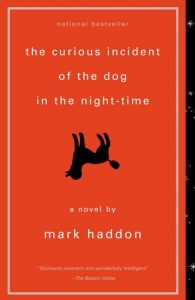 In May the Page Turners read Mark Haddon’s 2003 prize-winning novel, ‘The Curious Incident of the Dog in the Night-Time‘.
The narrative is told in the first person by 15 year old Christopher who lives in Swindon. He has been described by various commentators as having Aspergers Syndrome or being on the autism spectrum but Haddon himself has said that he is not an expert in these wide-ranging conditions and that Christopher is neuro-diverse and experiences the world in his own unique way. We were grateful that reading this book gave us an insight into the autistic mind, but recognise the need to bear in mind the great diversity of the condition.
Christopher discovers that his neighbour’s dog has been killed and he sets out to discover who could have done such a thing. Along the way he discovers family secrets which scare him and lead to him undertaking a journey way beyond his usual experience. We explore Christopher’s relationship with both his parents and how they have dealt with his condition. By the end of the book he is rebuilding trust within his family and is optimistic about his future, having realised what he is capable of achieving.
The book is written in a unique way as it portrays the way in which Christopher’s mind works. He likes lists and patterns and routine. He struggles to understand other people’s feelings and hates being touched and the colours yellow and brown. He is educated in a special school and has never made a journey on his own.
Having Christopher as the narrator challenged us to think about a very different world view. The book also made us think about the difficulties for parents living with and caring for a neuro-diverse child. Each of his parents coped differently with loving him but finding his behaviour and outbursts hard to manage and we were interested in the effect on the marital relationship.
The descriptive writing in the book was not what we are used to because Christopher had his own way of looking at people and places; some of us enjoyed this whilst others found it difficult.
Christopher was extremely good at maths and throughout the book there are some complex examples of his mathematical thinking – many of us found these parts too complicated.
We did not all love this book but most of us were glad we had read it. If you would like to try it for yourself, do get in touch and perhaps swap our page turner for one of your own.
Deborah Wallis, convenor