
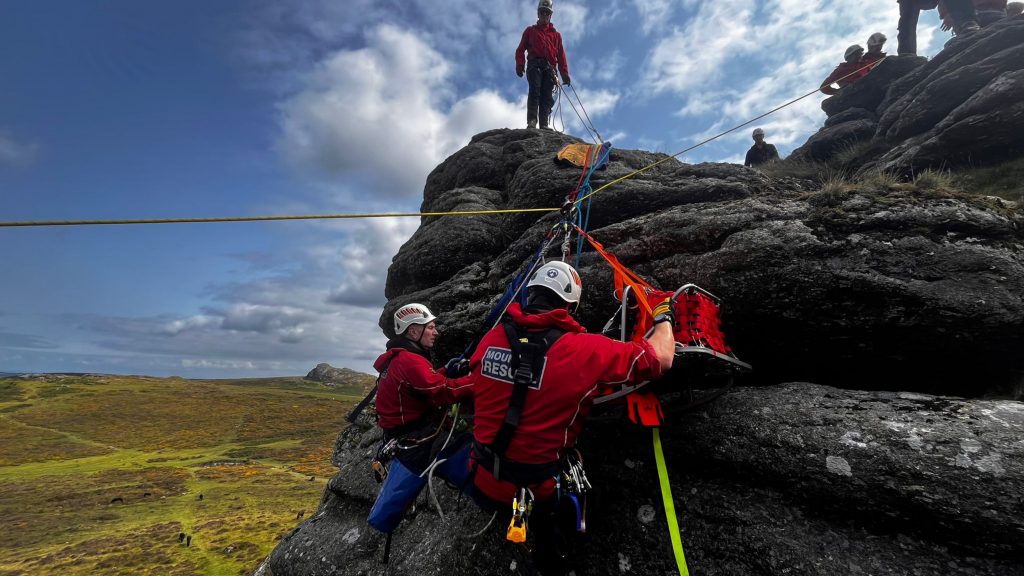
Monthly talk: Alan Pewsey – Dartmoor Search and Rescue
As our previously booked speaker was not able to come for personal reasons, we are grateful to Alan Pewsey, a volunteer for Dartmoor Search and Rescue, for agreeing to speak to members at very short notice.
Before listening to Alan talk about their work, I assumed that DS&R would mainly focus on walkers and others who get into difficulties when enjoying the Dartmoor National Park. That is rather wide of the mark and they have a much broader remit.
He began by telling us that 5210 ‘missing persons’ were recorded by the police in Devon last year, and that did not include Plymouth. Over 700 were classified as high risk. At any one time, the police are likely to be focussing their attention on about 15 of these high risk cases.
The police undertake an assessment to try to understand where the person might have gone and why they have gone missing. They may then refer the case to one of several organisations whose expertise may help. In addition to DS&R they might also call on HM Coastguards, caving organisations and mountain rescue groups across the region.
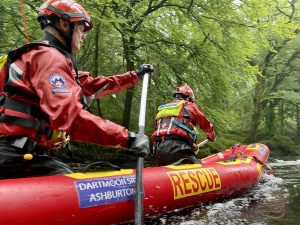
These cases may not be confined to the immediate area of the national park. While much of their work is in the immediate area, they are also likely to be involved in searches across the region, as far east as Lyme Regis and Wales. In 2015, they were called to York to assist those affected by severe flooding.
The majority of the people they are searching for are classified as ‘vulnerable’ – with mental health issues or at risk of suicide. These cases increase in the winter months. Children are a large group and they also search for horse riders, cyclists, kayakers and others who have come into difficulties while enjoying the outdoors.
The number of people who get into difficulties in remote areas is increasing, possibly due to use of social media. ‘Influencers’ and others post photos of beautiful scenes, encouraging others to see for them themselves but neglecting to include advice about suitable footwear and clothing, checking on the weather and other essential safety advice.
Technology plays a growing part in locating people. A considerable amount of data is used to assess the likely locations and behaviour of the different categories of missing people. For those who are lost or injured on moorland, mobile phones, satellite technology and other navigation aids are vital. We learned a great deal about new methods to seek help in emergencies in remote areas – including some valuable cautionary advice on ‘What Three Words’.
The current organisation was founded in 1968, building on the work of earlier volunteers. It has evolved over the decades, and now there are four separate teams within DS&R. All members are volunteers, as are those who work in the dozens of similar groups across the country. All of the 2800 men and 700 women are deployed in the same way regardless of age or sex. Typically, they will devote about five hours per week to this work, although frequently it is more. They come from all walks of life and occupations, and rely heavily on the goodwill and flexibility of employers to release them when an emergency demands.
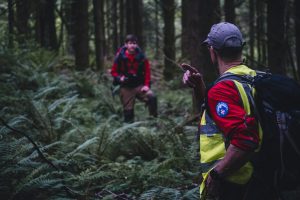
Dogs are also a vital part of the team. It takes up to three years to train a dog to detect a person in remote countryside, using their highly developed sense of smell, but once trained they can do the work of about 20 humans on foot.
Needless to say, it is an expensive operation to run, requiring a great deal of specialist equipment, fuel for vehicles and a large training programme. The UK budget is approximately £2.5m pa, and 92% of that comes from donations. Just 8% comes from government funding, so the need to raise funds is paramount. There were information leaflets available for those who wished to learn more, and how to donate money to assist in this vital work.
18th May – Big Cats of Devon
Next month’s speaker is Alex Bowler who will be talking about the ‘Big Cats of Devon’. He is a big cat investigator, who lives in South Devon. His unusual and interesting ‘hobby’ began as a result of being stalked by a black leopard on Croydon Hill near Dunster in Somerset on Christmas Eve 1985. Since then, Alex has seen pumas and black leopards in Somerset and Devon a number of times and has photographed, recorded and filmed them. He has also studied their field signs, such as scats, scrapes, footprints and claw marks on trees.
John Vick
Photo credit: Dartmoor Search and Rescue. Used with permission.