
Art Appreciation – December 2026
At our November meeting, Michael gave a presentation on the American artist James McNeill Whistler (1834-1903). Whistler is best known for his 1871 portrait of his mother. This painting is now so famous that it has been used and caricatured by cartoonists and other artists. Michael showed us that Whistler was a fascinating character who should be appreciated for far more than this one painting.
His father was an engineer whose work building railways took him from the USA to France and Russia where the young Whistler studied art. They then moved to the UK, but after his father’s death the family returned to the US and Whistler had to earn some money to support them so he had a brief career in the army. After being dismissed from West Point, he returned to France to pursue his main talent as an artist.
His early work was mainly focused on producing etchings of scenes of everyday life. He also developed a reputation for his landscapes and portraits. By the 1850s Whistler had made his home in England where he remained for the rest of his life and became a major figure in the artistic life of the country.
Unlike most artists of the period, Whistler cannot be associated with any particular artistic ‘school’ such as the Pre-Raphaelites or the Impressionists. He was one of a kind with very clear, indeed dogmatic, ideas about what art should be. In an age when Victorians often expected a painting to tell a story or have a moral message, Whistler asserted strongly that art should be for art’s sake and nothing else. This led to conflict with other artists and critics.
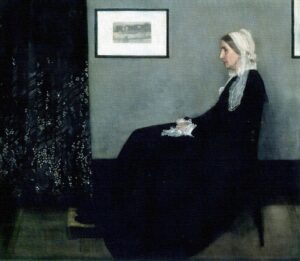
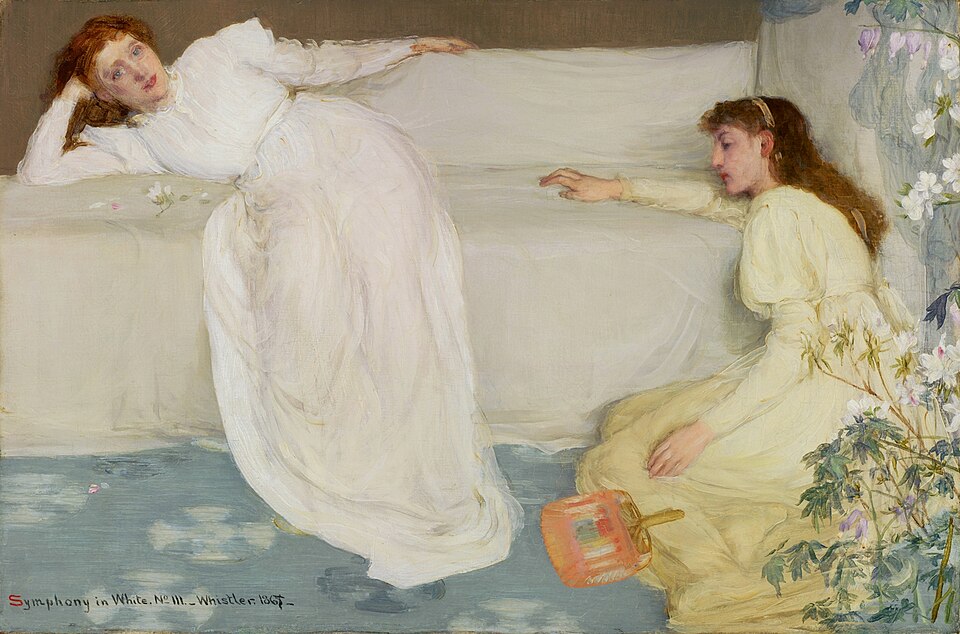
Many of his paintings, portraits or landscapes, have titles related to music and focus on a narrow range of colours. These include ‘Symphony in White’, ‘Nocturne in Blue and Green’ or ‘Variations in Pink and Grey, Chelsea’. Indeed, the portrait of his mother is really called ‘An Arrangement in Grey and Black No. 1’.
Like many artists of his generation, he was influenced by Japanese art and design, and this is apparent in many of the interiors, costumes and the poses of his subjects, often viewed from behind. Members particularly appreciated his skill in painting textiles. He achieved considerable success and gained commissions from many wealthy patrons.
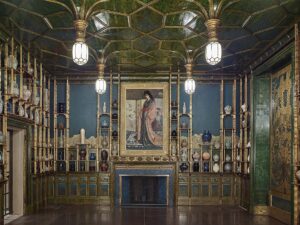
One of his most celebrated works is the Peacock Room, designed in 1876-7 for the Kensington home of his wealthy client, Frederick Leyland. Whistler used opulent materials and pursued the design without consulting his client. Leyland was surprised on returning to his home after an absence, to find that Whistler had not followed his brief. This resulted in a major breakdown in their relationship.
Whistler was an opinionated individual and seems to have had a talent for falling out with people. Indeed, he wrote a book titled ‘The Gentle Art of Making Enemies’. His most celebrated falling out was with the revered art critic John Ruskin who fiercely criticised ‘Nocturne in Black and Gold: the Falling Rocket’. He likened it to ‘flinging a pot of paint in the public’s face’. Whistler sued and won his case for libel, but the court awarded just a farthing in damages. The legal costs led to Whistler’s bankruptcy, and he had to leave England and spend time producing etchings of Venice in an attempt to restore his fortunes.
Whistler remained a major figure in British art while also achieving success in the United States where he had many notable commissions. He was a high profile personality to the end of his life, and his distinctive image as something of a dandy sporting a famous moustache, frequently appeared in magazines.
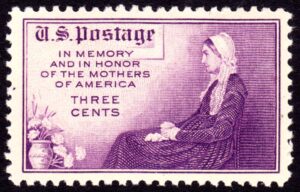
Since his death, Whistler has achieved a considerable reputation with his mother’s portrait appearing on postage stamps and statues. He probably inspired, at least in part, Gilbert and Sullivan’s character Bunthorne in their operetta ‘Patience’.
At our December meeting, members are invited to choose a work of art on the theme of ‘Weather’.
Lynne Vick, Convenor